Feeling Lost in the Home Insurance Maze? Understanding Replacement Cost vs. Actual Cash Value in California
Honestly, trying to make sense of home insurance in California can feel like wrestling a grizzly bear. You’re not alone. Many homeowners in places like the Inland Empire or even up in Humboldt County feel a deep anxiety about their policies. Premiums have jumped – sometimes 40% between 2022 and 2024 for some folks – and insurers are pulling back from high-risk areas. It’s a tough market. And when you finally get a policy, the language can be baffling. One of the biggest points of confusion, a detail that could truly save or sink you after a disaster, boils down to two terms: replacement cost and actual cash value.
Why What Your Policy Pays For Really Matters
Imagine your home in the Santa Monica Mountains, or maybe a cozy bungalow in Orange County. A fire rips through, or an earthquake hits, and suddenly, it’s gone. Devastating, right? Your insurance policy is supposed to be your safety net. But here’s the thing: what kind of net is it? Will it pay to rebuild your home as it was, brand new? Or will it give you a check that barely covers a fraction of the cost, leaving you high and dry? This is where replacement cost and actual cash value come into sharp focus. For many Californians, especially those who’ve seen neighbors struggle after a wildfire, this distinction isn’t just paperwork; it’s the difference between recovery and financial ruin.

Replacement Cost: The Gold Standard (Mostly)
Let’s start with the ideal scenario. Replacement cost coverage, often called RCV, aims to pay for the cost of rebuilding your home or replacing your damaged belongings with new ones, at today’s prices, without deducting for wear and tear. No matter if your roof was 15 years old, if it’s damaged by a covered peril, your policy would pay to replace it with a new roof of similar quality. This includes the current cost of materials – like lumber, which has seen wild price swings – and the labor costs for contractors, which are always climbing in California.
Think about a home in Ventura County after a major fire. Rebuilding takes time, and it’s expensive. Materials have to be sourced, skilled workers need to be hired, and permits secured. A replacement cost policy aims to cover *all* of that, up to your policy limits. It’s what most homeowners want, and frankly, it’s what most homeowners *need* to truly recover. Without it, you’re shouldering a massive financial burden yourself.
Extended Replacement Cost and Ordinance/Law Coverage
That’s not the whole story, though. Even with standard replacement cost coverage, you might run into issues. Construction costs can surge unexpectedly after a widespread disaster – think about the demand for contractors after a massive wildfire season. This is where **extended replacement cost** comes in. It provides an additional percentage of coverage, usually 20-25% above your dwelling limit, to account for these post-disaster price spikes. It’s a smart addition, especially in California, where large-scale events are a constant threat.
Which brings up something most people miss: **ordinance or law coverage**. When you rebuild, you’re often required to meet current building codes, not the codes that were in place when your home was first built. If your home was older, say from the 1960s in the San Fernando Valley, bringing it up to modern earthquake or fire-hardening standards can add significant costs. An RCV policy alone might not cover these code upgrades. Ordinance or law coverage steps in to bridge that gap. It’s a subtle but powerful protection.
Actual Cash Value: The Cheaper, Riskier Option
Now, let’s talk about actual cash value, or ACV. This is where things get a bit tougher. An ACV policy pays for the cost of replacing your damaged property *minus depreciation*. What’s depreciation? It’s the reduction in value due to age, wear and tear, and obsolescence.
Imagine that same 15-year-old roof. If it had a 20-year lifespan, an ACV policy might only pay 25% of the cost to replace it, because it was already 75% “used up.” You’d get a check for the depreciated value, and the rest? That’s on you. This applies to your belongings too. Your 8-year-old sofa, your 5-year-old TV, your clothes – all subject to depreciation.
Why would anyone choose ACV? Well, it’s cheaper. Sometimes significantly cheaper. In a state where insurance costs are soaring, and some homeowners feel desperate to find *any* coverage, an ACV policy can look appealing on paper. If you’re struggling to afford premiums from companies like State Farm or AAA, or if you’re getting coverage through the California FAIR Plan – which often provides ACV coverage for your dwelling and usually only for specific perils like fire – it might seem like the only option. But it’s a short-term saving that could lead to long-term financial pain.
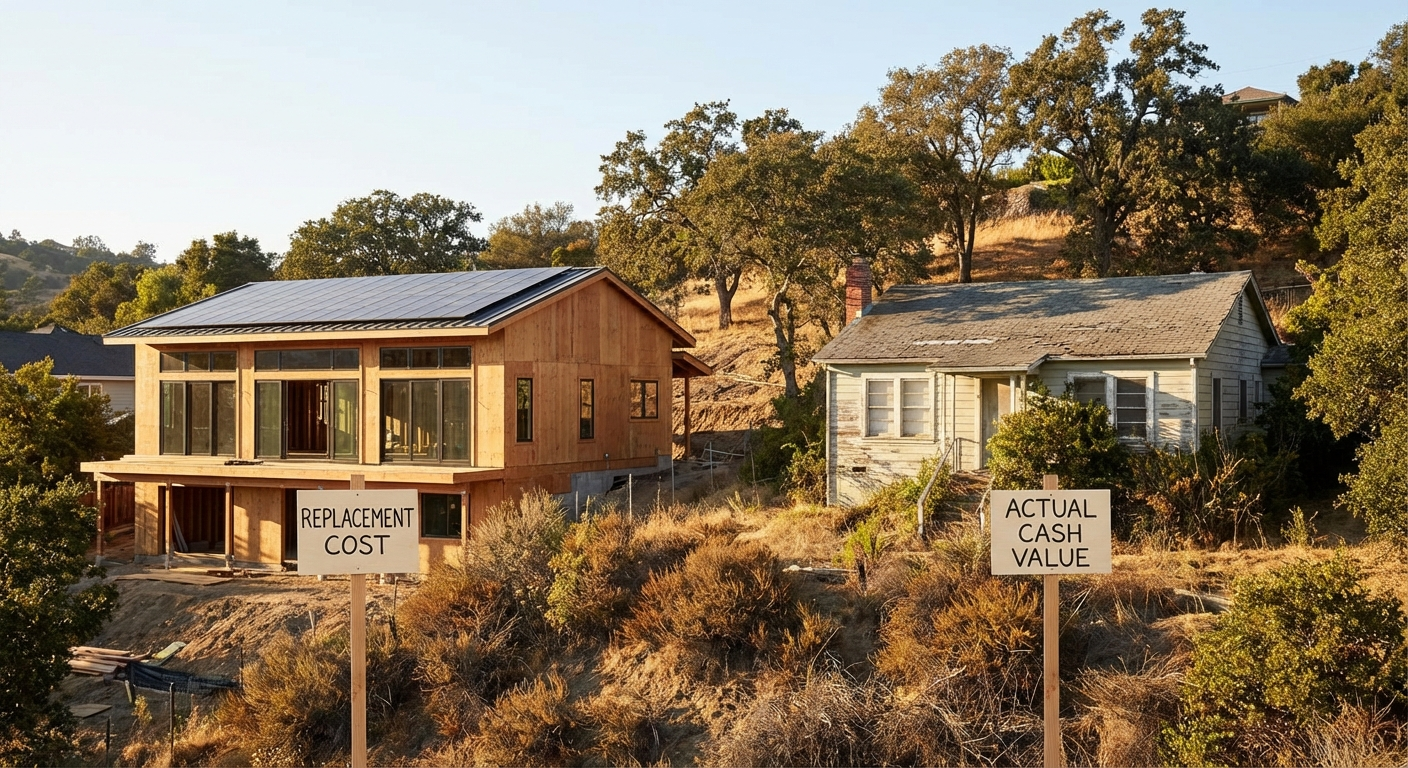
The Stark Difference: A Real-World Example
Let’s put it simply. You own a home in Placerville. A wildfire races through. Your home, built 30 years ago, is completely destroyed.
* **Replacement Cost Policy**: Your insurer estimates it’ll cost $500,000 to rebuild your home today, with current materials and labor. You get a check (or payments as reconstruction progresses) for roughly $500,000, assuming it’s within your policy limits and you have extended replacement cost. You can rebuild your life.
* **Actual Cash Value Policy**: The insurer assesses the current value of your 30-year-old home, accounting for its age and wear. They might say its “actual cash value” before the fire was only $300,000. You get a check for $300,000. That leaves a $200,000 gap that you have to cover out of pocket to rebuild the *same* home. Could you do that? Many Californians couldn’t.
This isn’t just hypothetical. We’ve seen this play out for families in Paradise after the Camp Fire, or in Coffey Park after the Tubbs Fire. People with ACV policies, or insufficient RCV, often found themselves with payouts far below what they needed to rebuild their lives and homes. They either had to take on massive debt, settle for a smaller home, or simply walk away.
Why This Matters More Than Ever in California
California’s unique challenges amplify the importance of this choice.
1. **High Construction Costs**: Labor and materials are expensive here. Period. Rebuilding a home in San Diego or even Modesto costs a lot more than in many other states.
2. **Wildfire Risk**: With increasing fire seasons, homes in high-risk areas—from the Sierra Nevada foothills to parts of Malibu—are constantly threatened. If your home burns, you need to be able to rebuild properly.
3. **Earthquake Risk**: While standard home insurance doesn’t cover earthquakes, if you have a separate earthquake policy, understanding its payout structure (RCV vs. ACV for dwelling and contents) is just as important.
4. **Insurance Market Instability**: With some major insurers like Farmers or Liberty Mutual adjusting their presence, and the FAIR Plan becoming a go-to for more people, understanding *exactly* what kind of coverage you’re getting is paramount. The FAIR Plan, while a safety net, often provides basic ACV coverage for your dwelling, requiring you to buy a “Difference in Conditions” policy from another insurer to get RCV and other protections. It’s complicated, and often leaves people feeling exposed.
Making the Right Choice for Your Home and Family
Honestly, it’s easy to feel overwhelmed. The insurance industry jargon, the shifting market, the constant worry about the next disaster – it’s enough to make anyone throw up their hands. But here’s the thing: you have options, and you have resources. Choosing replacement cost coverage for your dwelling and contents is almost always the smarter, safer bet. It costs more upfront, yes. But it provides true peace of mind and financial security if the worst happens.
If you’re unsure about your current policy, or if you’re looking for new coverage, don’t just guess. Talk to someone who knows the California market inside and out. Someone who can explain these differences in plain language and help you find a policy that truly protects your assets. Karl Susman of Affordable Home Insurance California, CA License #OB75129, has been helping Californians navigate these complex waters for years. He understands the fears and frustrations you might be feeling.
You deserve to understand what you’re paying for. You deserve to feel confident that your home and your family’s future are protected. If you’re ready to get clarity and explore your options, you can reach out for a personalized quote.
Get a Home Insurance Quote Today
Frequently Asked Questions About Replacement Cost vs. Actual Cash Value
Q: Is replacement cost always available for my home in California?
Not always. While most standard homeowner policies offer replacement cost for your dwelling and personal property, if your home is in a very high-risk area (like a severe wildfire zone) and you’re getting coverage through the California FAIR Plan, your dwelling coverage might initially be actual cash value. You’d then need to purchase a supplemental “Difference in Conditions” (DIC) policy from a private insurer to upgrade to replacement cost for your dwelling and add other coverages like liability.
Q: How does depreciation work for personal belongings under ACV?
For personal belongings, insurers typically use a depreciation schedule based on the item’s age and expected lifespan. For example, a television might have an expected life of 7-10 years. If your 5-year-old TV is destroyed, the insurer would subtract a percentage of its original value for those 5 years of use, paying out only the remaining “actual cash value.”
Q: Does replacement cost mean I get unlimited funds to rebuild?
No, replacement cost coverage is still subject to the limits you select for your dwelling and personal property. If your home is insured for $600,000, that’s the maximum the policy will pay, even if rebuilding costs exceed that. This is why having enough coverage, often including extended replacement cost and ordinance/law coverage, is so important, especially in California’s high-cost environment.
Q: Can I have replacement cost for my dwelling but actual cash value for my personal belongings?
Yes, sometimes. Policies are often structured to offer replacement cost for the dwelling and actual cash value for personal property as a way to lower premiums. However, you can usually upgrade your personal property coverage to replacement cost for an additional premium. It’s almost always a good idea to do so, as replacing all your household items out of pocket is incredibly expensive.
Ready to talk through your options and ensure your California home is truly protected? Don’t hesitate to connect with a knowledgeable professional.
Speak with an Expert and Get a Quote
You can also call Karl Susman at Affordable Home Insurance California directly at (877) 411-5200 for personal assistance. CA License #OB75129.
This article is for informational purposes only and does not constitute financial advice.